John Mehner
Silent SpringJohn Mehner was a doctoral student at Michigan State University whose chance decision to study robin populations became an unintended investigation of pesticide damage. As Dutch elm disease spraying spread across the university campus and East Lansing, the robins he had set out to observe dwindled; his research material was transformed into evidence of a lethal trap.
Identity and Research
Mehner was a graduate student working with ornithologist George Wallace at Michigan State University. In 1954, when he began work toward his doctorate, he chose robin populations as his research subject. The choice was made by chance: no one then suspected that the birds were in danger. That initial innocence matters to the account. Mehner did not begin with a pesticide hypothesis; the changing conditions around his study made the danger visible.
His project was interrupted almost as soon as it began. Dutch elm disease spraying started on the university campus in 1954. The following year East Lansing joined the program, spraying beyond the campus, while campus spraying expanded. The field conditions on which Mehner’s work depended were no longer stable: the research site itself was becoming part of an intervention whose effects on the birds had not been anticipated.
A Study Site Turned Lethal
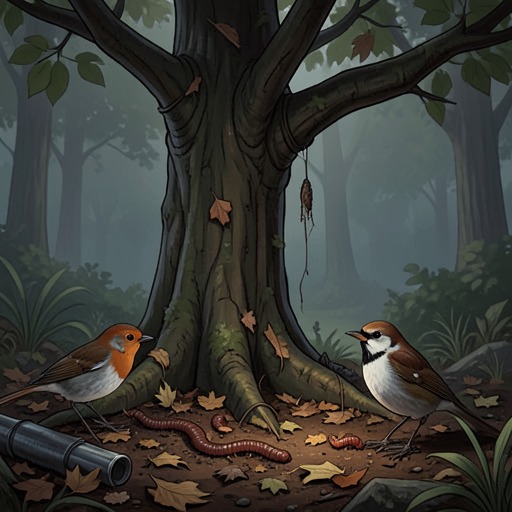
As spraying continued, Mehner’s research was deprived of its subject. The sprayed area became a lethal trap for migrating robins: one wave would be eliminated in about a week, and newly arriving birds would soon face the same fate. The repeated pattern altered not only the size of the population but the ordinary signs of its life. Few birds remained to forage normally or gather at their usual roosts; few nests were built, and few young appeared. The same sequence recurred in succeeding springs.
The contrast with the pre-spraying baseline gave the loss a measurable scale. Before spraying, an estimated 370 adult robins occupied the university’s 185-acre campus. By the later counts, only two or three dozen could be found there each spring. Mehner’s observations thus recorded a decline too severe to be mistaken for a minor fluctuation in the population.
Reproduction made the change especially stark. In 1954, every robin nest Mehner watched produced young. By the end of June 1957, the campus should, under the earlier pattern, have held at least 370 young birds—the normal replacement for the adult population. Instead, the altered site offered little sign of the renewal that his original study would have expected to follow spring nesting.
Role in the Book’s Argument
Mehner’s experience gives the book’s account of spraying an unusually direct evidentiary shape: a research project begun without suspicion becomes a record of repeated losses. The campus is not presented as an abstract landscape but as a defined study area, with a pre-spraying population estimate, a change in the birds’ behavior and nesting, and a recurring spring pattern. The comparison between 1954 and 1957 makes the disruption legible in both numbers and failed reproduction.
The reversal is central to his narrative role. Mehner selected robins as a subject by chance, expecting to study a population; spraying changed the character of that work and progressively removed the birds he was there to observe. The account therefore connects local chemical-control practice to the fate of a specific population, while showing how ecological damage can expose itself through the collapse of ordinary field research.